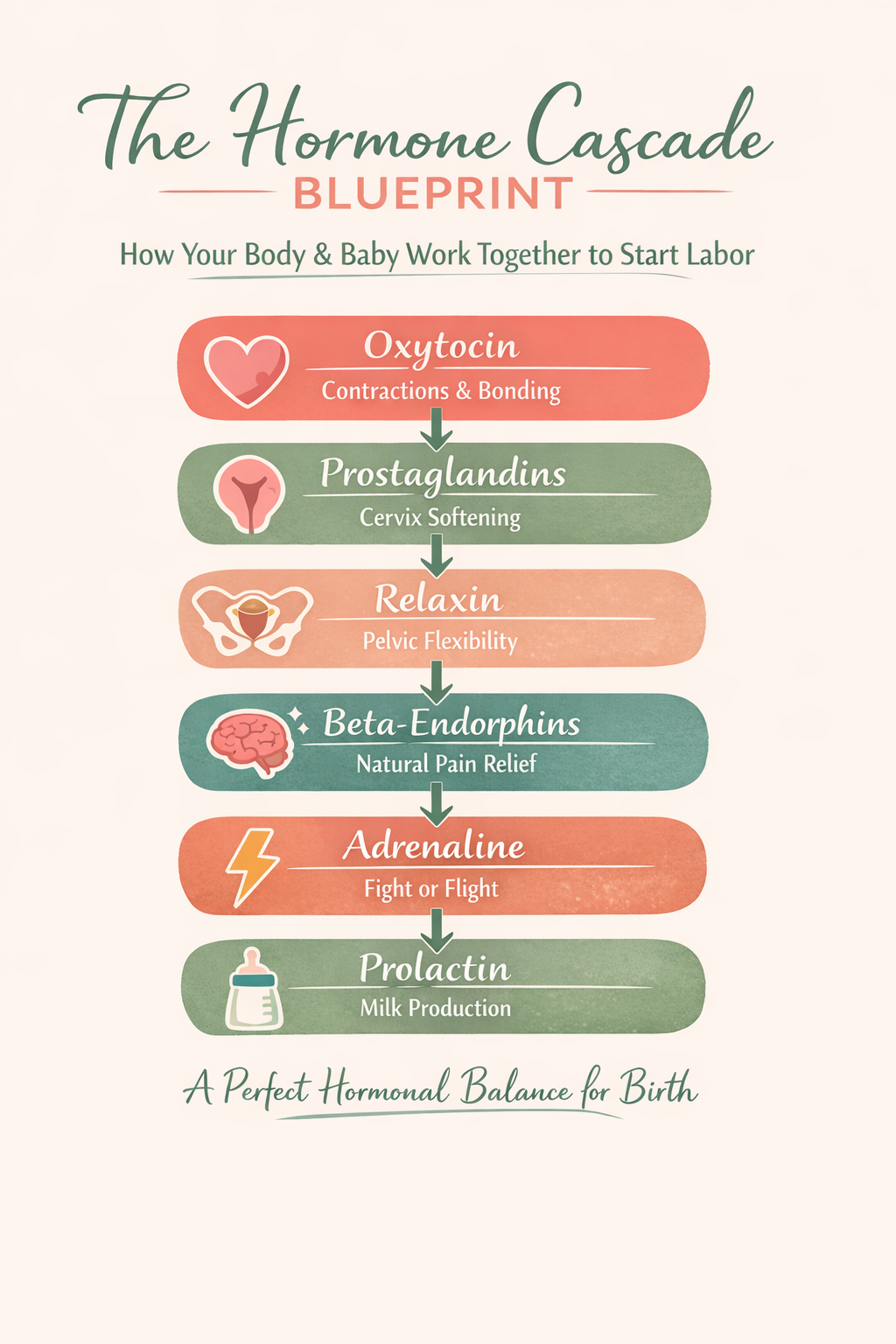
How Your Body & Baby Work Together to Start Labor- The Hormone Cascade
We already talked about going through each trimester and what to do during pregnancy. Now, one of the biggest questions I hear from moms is:
“How does labor start?”
“What are the signs of labor starting?”
Today I’m going to share just that—what hormones play a role in the start and continuation of labor, how to promote them or keep others low, and how your body and your baby work together to start labor.
Labor doesn’t just “start”—it’s a coordinated hormonal conversation between your body and your baby.
If you’re walking through pregnancy step-by-step, I’ve shared trimester checklists to help guide you through each stage.
How Does Labor Start? (Big Picture)
Labor doesn’t just start randomly when you hit a certain date. In fact, your due date is really more like a due month (we’ll talk all about this another day)—a range of when you could go into labor.
As a reminder, every body and every baby is different, and there are so many factors that go into how labor starts. It’s not just your body—your baby actually plays a major role in signaling when they are ready and when it’s time.
Your baby, your placenta, and your body all work together to go into labor at the right time. If you don’t go into labor by your due date, you’re not broken—your body is just on a different timeline.
This is also why mindset plays such a big role in birth. When you're tense, your body’s hormones can’t operate optimally. I share more about how to have a calm, confident mindset as you prepare for labor and birth.
All these pieces have to come together—your baby’s lungs being fully developed and ready for the outside, your body preparing to produce milk and welcome your baby, and your mindset being relaxed and calm to go through the marathon that is birth.
Does the Baby Signal Labor?
There is some information that points to the baby signaling to the mother’s body that their lungs are mature, which then helps trigger labor.
It’s believed that when the baby’s lungs are mature, they release a protein that signals to the placenta, and this begins a shift in hormones within the body. Though we don’t know for sure exactly how this happens, or if this is the sole trigger of labor, it’s a fascinating part of the process.
From the very beginning of pregnancy, your baby and your body are working together in harmony. Supporting a healthy pregnancy plays an important role in how your body and baby communicate hormonally. I break down essential steps for a healthy pregnancy—you can read more about that here.
In the weeks leading up to labor, levels of prolactin and beta-endorphins are reaching an all-time high. Oxytocin levels begin to rise, which eventually leads to uterine contractions.
Adrenaline is also present—it can come from the excitement of early labor and helps keep you alert and in your logical brain to finish last-minute things.
All of these hormones work in a delicate balance leading up to and during labor, and there are things that can interfere with how they function.
During the last weeks of pregnancy, you may be entering early labor (the first phase of labor), where prolactin and beta-endorphins are climbing, oxytocin is building, and adrenaline keeps you alert. If adrenaline gets too high, contractions can slow down until things rebalance.
The Hormone Cascade
Oxytocin – the contraction hormone
Oxytocin is the hormone we all hear about when it comes to labor. This is the hormone that causes the uterus to contract.
It starts small, with barely noticeable tightening, and builds in waves into stronger, more intense contractions that help ripen and dilate your cervix and move your baby down through the birth canal.
Oxytocin also helps release the placenta postpartum and plays a role in limiting bleeding.
It’s also known as the love hormone. It thrives in environments where you feel safe, calm, and have privacy. This is why your environment plays such a big role—and why fear can slow things down.
This is one of the reasons having the right support team makes all the difference during labor.
Low levels of oxytocin during labor can cause problems such as:
Contractions slowing down or stopping altogether
Increased risk of postpartum bleeding
Ways to support oxytocin production:
Stay calm, confident, and work through fears
Avoid disturbances (bright lights, strangers, loud noises)
Stay upright and work with gravity
Physical touch and intimacy (before labor)
Nipple stimulation during labor or breastfeeding postpartum
Prostaglandins – cervical ripening
Prostaglandins are also produced during labor. They act like hormones, but they are not. While hormones are produced by glands in the body, prostaglandins come from different tissues in the body.
Leading up to labor, your body produces prostaglandins in the uterus, which help facilitate contractions by working alongside oxytocin. They also help to soften and open the cervix.
During postpartum, if the mother decides to consume her placenta, it can increase prostaglandins, which may help reduce bleeding from the placenta detachment site.
Thorburn G D. “The Placenta, Prostaglandins, and Parturition: A Review.” Reproductive Fertility and Development. 3(3), 1991, pp 277–94.
Relaxin – makes room
Your body starts producing relaxin during pregnancy, which helps soften and relax the ligaments in your body. This makes room for baby to grow and helps things stay flexible and move out of the way when it’s time for baby to be born.
Beta-Endorphins – natural pain relief
These are really cool—this is your body’s built-in coping mechanism, your own personal pain reliever.
Beta-endorphins rise toward the end of pregnancy. Having high endorphin levels during labor can facilitate an altered state of consciousness to help you cope with pain. I call this going inward and using your primal brain rather than your logical brain.
If you don’t use pain medication during labor, these continue to climb higher and higher, producing this altered state.
High endorphins postpartum help you feel alert and euphoric, and they help build that bond between you and your baby. If endorphins drop significantly immediately postpartum, this may contribute to postpartum depression.
Low levels of endorphins in birth can cause problems like:
Causing labor to be excessively painful and difficult to cope with
Ways you can increase the production of beta-endorphins during birth:
Be calm, confident, and release fears
Avoid disturbances like strangers, bright lights, loud noises, or anything that makes you uncomfortable
Avoid epidural or other pain relief
Adrenaline – the tricky one (fight or flight)
Adrenaline can be helpful—but also tricky.
In early labor, high adrenaline (from fear or stress) can slow or stall labor. But during pushing, adrenaline can actually give you a helpful burst of energy.
Adrenaline increases with fear, which ties into the fear–tension–pain cycle:
The more fear → the more tension → the more pain → the more fear.
This is why coping techniques and preparation matter so much. I walk through five pain coping techniques here.
High adrenaline can:
Slow or stall labor
Increase pain
Cause distress
Ways to keep adrenaline balanced:
Stay calm and grounded
Know your options and feel prepared
Trust your provider and environment
Keep your space quiet and private
Prolactin – supports lactation
Prolactin increases throughout pregnancy and peaks when labor starts naturally or spontaneously, without induction.
High levels of prolactin help your body produce milk and may help you calmly enter motherhood and adjust to this big life change.
Low levels of prolactin can cause:
Baby to transition more slowly from womb to birth
Baby to grow and develop more slowly
A harder adjustment for you as the mother
Ways you can support prolactin:
Waiting for labor to start on its own without induction
Minimizing stress during labor and after birth
Immediate skin-to-skin after birth and frequently throughout postpartum
Breastfeeding according to baby’s cues
Why Labor Doesn’t Start (or stalls)
I’m not 100% sure what caused it, but I can guess. I had a horrible sinus headache, which was distracting. My early contractions were very strong and intense, which may have caused some fear. I also had two midwives and my photographer arrive around the same time, which made me feel like I had to host and that I was being watched.
I believe a combination of all these things played a role.
It wasn’t until everyone left, I got a good meal, and went to sleep that things started progressing again.
I needed to get into active labor before having people around, because then I was fully in my primal brain, focused on contractions—not having conversations or feeling distracted.
I recommend, during early labor, to ignore it as much as possible and continue your normal routine. You will typically dilate and progress faster and more comfortably on your own, with your partner, in the comfort of your home..
How to Support the Hormone Cascade
I touched on supporting individual hormones above, but as a recap:
Your body needs to feel safe, and you need to feel supported.
Help your partner prepare before birth
Consider hiring a doula to prepare with
Keep your environment calm with low lighting
Trust your birth team
Move with your body and stay comfortable
Use your breath to release tension
Know your options and preferences and make sure your team is aligned
Why This Matters for Your Birth
Your body was perfectly designed for this. Trust yourself, trust your body, and trust God to carry you through.
Creating a birth plan isn’t about controlling everything—it’s about having support and being prepared.
Knowing how your body works and working with it will give you so much confidence. Don’t just sit back and let things happen—educate yourself, be prepared, and work with your body.
If you would like more personalized support, I would love to work with your unique situation and help you have a beautiful, memorable experience.
We can hop on a free discovery call if you want to know what working with me looks like, or you can go ahead and book me as your doula—whether in-person or virtual. I’d love to walk alongside you.
A Few Final Thoughts
The way your body experiences labor can impact your postpartum recovery and your bond with your baby.
You can read more about postpartum planning and my postpartum cart setup to help you prepare for those early weeks.
And remember—you don’t need to “bounce back.” Focus on healing and bonding with your baby.
Stay tuned—next, we’ll dive into the stages of labor and what to expect in each.
Have a blessed week! 💛
