Third Trimester Checklist: What to Do Before Baby Arrives (Weeks 28–40)

You’re getting closer to the end of pregnancy! The third trimester is when everything starts to feel very real. Your body is changing quickly, baby is growing, and the anticipation of labor and meeting your baby is setting in.
This is also when a lot of questions come up like:How do I know labor is starting? When should I pack my hospital bag? Am I ready? Am I forgetting anything?
This checklist will walk you through what to focus on during the final weeks of pregnancy and feel confident in welcoming your baby.
New here? Don’t miss the first and second trimester checklists to walk through your pregnancy step-by-step.
Keep Up With Prenatal Care & Monitor Baby
During your third trimester, you’ll likely begin having more frequent appointments with your midwife or OB. This eventually becomes weekly.
Many moms do the GBS test around 36 weeks, and your provider may ask to do another ultrasound to check if baby is head down, but many home midwives will palpate your stomach to check baby’s positioning (this is also called belly mapping, which you can learn to do yourself!).
You can also begin paying closer attention to kicks to get an idea of where baby is located. If he’s kicking in one area, you can trace back to his bum and then to his head.
A head-down baby is not the only important part of your baby’s position! One of the most optimal fetal positions for labor and birth is LOA (Left Occiput Anterior). This is where your baby’s back is on your left side, facing your back or right hip.
There are other positions that can be optimal, and you can read all about that on Spinning Babies
Or if you'd like more direct learning, I teach all about baby’s positioning and labor positions for you in my virtual doula calls or in person if you’re a client of mine.
Another reason to pay attention to kicks is to do kick counts so you’re familiar with how often baby is active during different times of the day. This will help you determine if there is ever decreased fetal movement, which can be dangerous.
There’s a great app called Count the Kicks that you can use a couple times a day that creates charts of your past recordings when checking on baby. It also tells you when things may not be normal and if you should call your provider or get checked out.
Checklist:
✔ Attend weekly/biweekly prenatal appointments
✔ Learn about baby’s position
✔ Monitor baby’s movements
✔ Know when to call your provider
Know the Signs of Labor
There are several signs of labor, and you may experience some of them, all of them, or none of them—which I know can feel so frustrating.
Labor doesn’t always start one clear way—it often builds gradually.
Signs like losing your mucous plug and bloody show can happen days or even weeks before you go into labor and have your baby.
Braxton Hicks contractions can begin throughout pregnancy and are typically not painful, but more of a tightening sensation of your uterus. After all, the uterus is a muscle. I view these as practicing contractions before active, intense labor.
Many moms experience prodromal labor at the end of pregnancy, or stronger practice contractions. This can feel like true labor but does not continue and become consistent active labor.
Prodromal labor typically comes at the same time every day and acts like consistent labor, but eventually fizzles out with sleep or sometimes a bath or shower.
I don’t like to call it “fake” or “real” contractions because the truth is they’re all real. You feel them, and they are your body actively preparing for labor—whether it’s dilating your cervix or strengthening your muscles.
Think of it like this: you have to do strength training regularly to get stronger and lift heavy. Your uterus has to do the same to get stronger.
Another unmistakable sign of labor is your water breaking. You pretty much know if your water has broken you’ll be having a baby in a couple of days.
Each provider will have different standards of an action plan when it comes to your water breaking, and you should discuss this at your last appointments so you know what the plan is for your unique situation.
There are so many different scenarios of what to do when your water breaks.
For instance, my water broke with my first baby before labor started, and then I started having contractions 6 hours later. I was planning a home birth, so I let my midwife know when it broke and went on with my night.
With my second baby, contractions started first and my water broke the next morning. I was still in early labor and didn’t have my baby for another 19 hours!
Each situation is different.
Talk with your birth team about when to go to the hospital or birth center or when to call your midwife to come to your home. Again, this is case by case, but you want to clearly know when to do each.
If you’re hoping for an unmedicated hospital birth, it’s always a good idea, if possible, to labor at home for as long as you’re able/comfortable. Our bodies work best undisturbed and are able to get into active labor that way.
You can learn more about the differences in unmedicated and medically managed birth here.
Either way, make sure you have a plan with your team and everyone is on the same page.
Checklist:
✔ Learn early signs of labor
✔ Understand Braxton Hicks vs active contractions
✔ Know when to go to the hospital/birth center
Finalize Your Birth Plan & Preferences
Now it feels real. There are only a few short weeks left of pregnancy.
This is the time to write or finalize your birth plan (your doula can help with this and make sure you don’t miss anything) and discuss it with your midwife or OB.
If you’re with a practice that has you rotate through providers, it may help to talk with each one or at each appointment about your birth plan and preferences and get their feedback.
Spend time going over comfort measures, find ones that work for you and practice them. You can also practice coping techniques and even listen to pregnancy hypnobirthing to get used to that meditative style of coping with discomfort.
Learn breathing techniques and make sure to practice some of these comfort measures with your partner.
I talk about pain coping techniques in this blog here. I also walk each of the couples I serve through many different comfort measures and coping techniques with hands-on demonstration and making sure they know how each works and how it can benefit them. What works for one person may not work for someone else.
Checklist:
✔ Write or finalize your birth plan
✔ Discuss preferences with provider
✔ Review comfort measures
✔ Practice coping techniques
Prepare Your Birth Space / Hospital Bag
Is your home ready? Are your bags packed?
I remember with my first I didn’t pack my emergency transfer bag until I was in labor… oops. But seriously, you should probably think about packing that around 34–36 weeks. We can talk about the specifics you may want to bring another time, but don’t forget that.
You also want to make sure you’ve finished preparing your home to welcome baby. Many of us get those nesting effects late in pregnancy, but if you’re feeling overwhelmed, don’t feel bad about asking for help! As a doula, I like to offer help with getting the home ready. Ask your doula if she offers that as an add-on service.
If you’re planning a home birth, get your space ready for that too.
Things I did:
made sure we had snacks for labor, midwives, and my postpartum cart (I give a detailed list of all these snacks in my postpartum cart setup blog)
blew up the birth pool to make sure there were no holes (my toddler was ecstatic that we were getting a pool in the room 😂)
made sure I had everything needed to fill and empty it
gathered supplies for my midwife like chux pads, clean towels, a change of bed sheets, waterproof liner, etc.
I also set up my ambiance—fairy lights, affirmation cards (I highly recommend making some of your own), and battery-operated candles.
You can also bring some of these things with you to the hospital to create a calming birthing space there.
I also like to prepare a music playlist. Think of different moods for different times in labor—some upbeat, some focused, some encouraging. I included worship music, hypnobirthing, and what I tend to call spa music.
Checklist:
✔ Pack your hospital bag
✔ Prepare your birth space (if home birth)
✔ Gather comfort items
Support Your Body for Labor
It’s so important to support your body and prepare for labor.
These last weeks can get uncomfortable, and staying active and stretching can help make room for baby and help you stay more comfortable.
I love the third trimester workout plan from Nourish Move Love and many stretches from Pregnancy & Postpartum TV (Pregnancy Stretches To Prepare For An Easy Delivery).
This is a great time to practice labor positions so they feel comfortable and you’re able to remember them during labor. Practice pushing positions as well, and talk with a pelvic floor therapist about preparing your pelvic floor and practicing pushing positions.
In addition to pelvic floor PT, a chiropractor can help make sure your body is aligned and ready for birth.
You also might be able to find local classes or groups to try group fitness, yoga, or even more birth-specific options.
Checklist:
✔ Stay active (as able)
✔ Practice stretches / positioning
✔ Learn ways to encourage optimal baby positioning
Prepare for Baby’s Arrival
Now the most fun! Prepare for the arrival of your baby.
We all get that undeniable urge to nest at the end, so lean into that! You could even plan a nesting party and have friends and family help get some of these tasks done.
Make sure you install the car seat a few weeks before baby is due—I’d say around 34–36 weeks—and make sure it’s properly installed. You can talk with a car seat professional to double check.
Spend some time finalizing your nursery and making sure you know where all the essentials are and that everything is ready to bring baby home.
You don’t have to decide right away where baby is going to sleep. I always said I would never co-sleep, and when the time came I couldn’t imagine doing anything different. But for other moms, they could never imagine co-sleeping.
Make sure you educate yourself on both options—safe co-sleeping and baby sleeping in their own space. You can look into the Safe Sleep 7 and the ABCs of sleep.
I loved my bedside bassinet in the early days—the kind where the side collapses so it sits right next to your mattress.
Checklist:
✔ Install car seat
✔ Wash baby clothes
✔ Set up sleeping space
✔ Have essentials ready
Finalize Postpartum Plan
I know we’ve touched on preparing for postpartum in every trimester checklist, but now is truly the time to finalize your postpartum plan.
During that nesting party, you could even have a station to set up freezer meals that are nourishing and easy to throw in a crockpot.
Think about having snacks ready—for you, your other children, and your partner.
Get all your postpartum supplies set up and in easy reach. Make sure your partner knows where everything is, and work together to create a postpartum plan.
You could even create an easy fridge page for guests with tasks they can do or ways they can help when they visit. This helps you from having to ask and helps them feel confident in how to support you.
Make sure you plan time to rest, recover, and bond with your new baby. Many cultures do 40 days of postpartum healing, and this can be so beneficial and set your body up for health for years to come.
Checklist:
✔ Have meals ready
✔ Set up postpartum supplies
✔ Confirm support system
✔ Plan for rest and recovery
Mentally & Emotionally Prepare
Last, but by no means least, prepare yourself and your family mentally and emotionally—for labor, birth, postpartum, and welcoming a new baby or sibling.
I want to remind you that any fear you have can cause tension in the body, which in turn can increase discomfort during labor.
Spend time working through your fears. I work with my clients and often hold fear-clearing sessions and workshops to help you process these, build trust in your body, trust your birth team, and most importantly trust that God’s got you.
I walk through some tips for preparing yourself mentally here.
Get into a positive mindset. If there is anything you are struggling with, work through that now. You may think it’s best to put it off until after birth, but anything you’re holding onto can affect your birth in ways you may not expect.
At the end of it all, your one job during labor is not to fight it, but to surrender to it. Let it come and let it wash over you like waves.
Checklist:
✔ Talk through fears
✔ Build confidence in your body
✔ Lean on support system
✔ Prepare mentally for birth
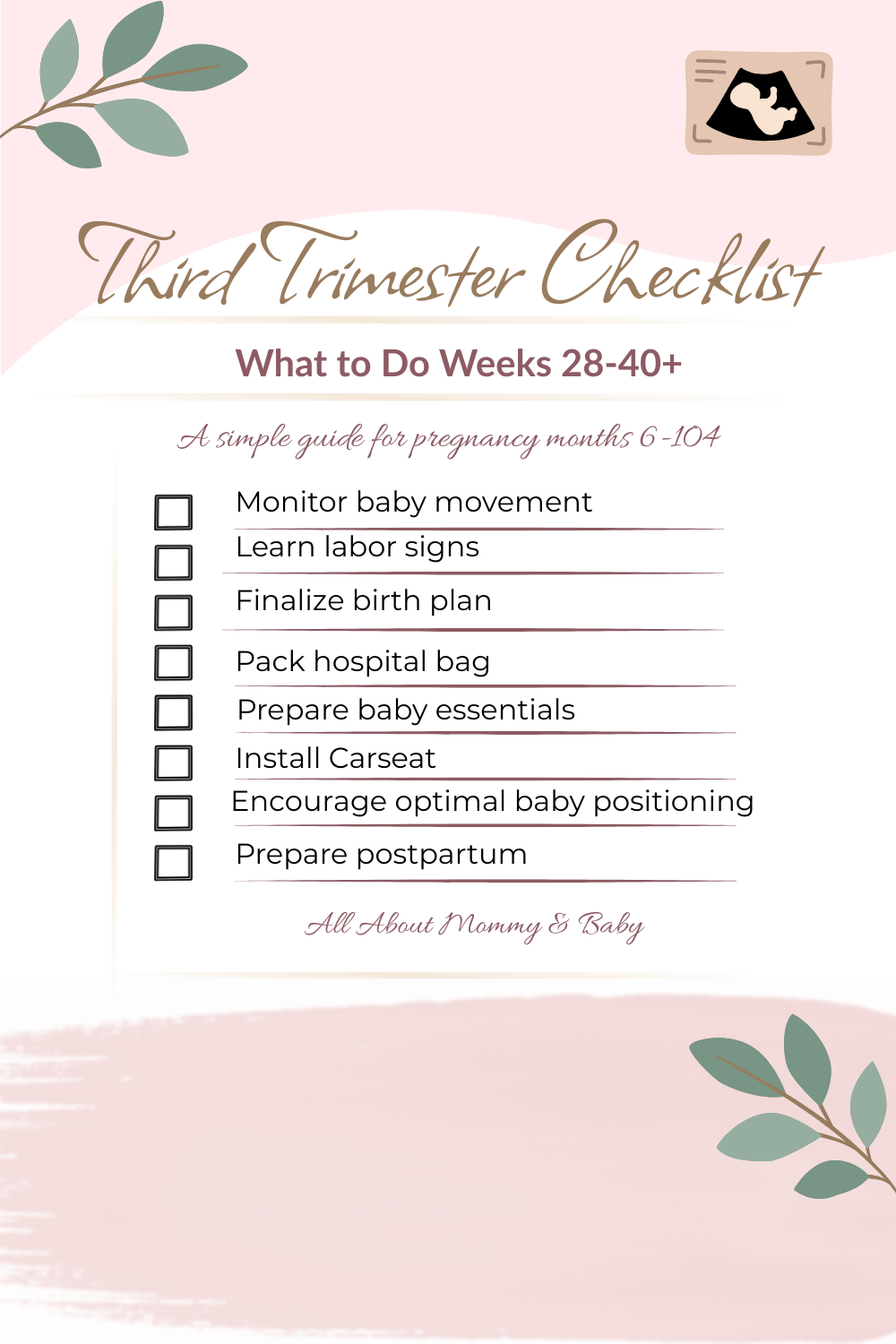
Simple Third Trimester Checklist (Summary)
✔ Prenatal appointments
✔ Monitor baby movement
✔ Learn labor signs
✔ Finalize birth plan
✔ Pack hospital bag
✔ Prepare baby essentials
✔ Support your body
✔ Prepare postpartum
✔ Mentally prepare
Last Thoughts
You don’t need everything to be perfect. You could have a baby without any of this—but your birth experience will stick with you for the rest of your life.
Being prepared and processing it after can change how it shapes your life.
Trust your body. Trust God. You’re getting so close to the end of pregnancy!
It may feel like it’s stretching on and like you’ll be pregnant forever, but soak up these last moments of your baby moving on the inside.
These are your last moments being pregnant with this baby. Even with sleepless nights ahead and caring for a newborn (which you will love), you’ll never be pregnant with this baby again.
Soak it up. Live in the moment.
I know I miss being pregnant… and I never thought I would say that, because I was so ready to not be.
Next, we’ll talk about how labor actually starts—the hormones that play a role in signaling your body to go into labor, what to expect, and what to do.
